Tuesday, July 03, 2007

Monsoon Season

Image of monsoon with lightning
June was a cruel month. The rain fell relentlessly washing away so many hopes and dreams.

It poured through the sills of the living room in the Leamington Garret, after a freak downfall which overwhelmed the guttering, scoring a direct hit on my vinyl LPs, CDs and tapes. I discovered what had happened when I tried to switch on my old music centre - and got a large electric shock. Two hundred and forty volts running from the casing, which had shorted to live, through me to earth. Never had the sticker on the centre - the Power in Music - seemed so apposite.

Nearly all my music was soaked through. Last week was hellish with the Garret stinking of damp, with every LP cover and sleeve and CD or tape notes spread out on the floor to dry. It is amazing how much space LPs and CDs take up when fully unwrapped. There was not a spare square inch in our living room.

It has been a tough time for other reasons. The day-job has been hard. I haven't taken a break since February and the daily grind has been getting me down. As has the weekly commute, made more tortuous by the incessant rains and my ailing constitution. I feel jaded. I have not even taken any photographs this month, as you will see from the dearth of them on this particular blog.

On the night that the Leamington Garret was flooded, however, I did venture to Coventry, which was virtually submerged, to make my poetry debut on the local radio station, BBC Coventry and Warwickshire Radio. I was on for about half an hour, with the station's "Poet Laureate" Jo Roberts - a most amiable lady - and the presenter Alan. Jo read a topical poem and then I read three of mine, Women, Cook And Drive, and Lose Hill.

Between poems we chatted about the state of modern poetry and, to a lesser degree, comedy. I was pleasantly surprised by how interested the presenter was. It was a really good conversation.

But it was soon back to reality. My head has been in all sorts of places in June and, after making a big effort to put a good selection of First Anniversary poems on the Oliver's Poetry site, I found it hard to get down to writing or revising my poems. Although I have plenty of ideas for new poems, I haven't started writing any of them.

I did, however, make an effort to learn some of the old ones, through tape-recording them and playing them repeatedly on my long commutes. Partly for this reason, I had a great gig at the Word in Leicester, where I performed Probably Not, I Fought The Law And I Won, and Chav.

It has not been a very creative time, though, partly because I feel burnt out by my continual efforts to find a day-job closer to home. After applying to the local council - the most difficult and time-consuming form I have ever completed; it took a week of my evenings to do - and not even getting an interview or a call back when I phoned them, I almost lost the will to live! I fear I shall be stuck in Leamington forever.

At least Tony Blair has gone. He is a remarkable character but I do not think he was a good Prime Minister. I was trying to think what is Blair's true legacy. Did he make Britain more peaceful? (because of Northern Ireland), or more bellicose? (Iraq), or nicer? (as Matthew Parris has suggested). No. His legacy is making Britain much more bureaucratic.

Over his 10 years at Number 10, almost every part of British society has been pervaded by a Civil Service culture, where form-filling, grant-applying, process of every ilk, and generally gratuitous pen-pushing has usurped real work. Where once Britain was a nation of shopkeepers, now we are a nation of bureaucrats. This is Tony Blair's true legacy.

I quite like Gordon Brown. I have fond memories of the occasion in the 1998 when he phoned me up for a chat about Scottish football (I was writing an article for a supplement in The Times). He was good humoured and witty, even it must have been absolutely obvious to him that my only knowledge of Scottish soccer was coming out of a two quid book I had purchased at the corner shop. He certainly did not embarrass me by pointing out my ignorance. But whether he cuts the red tape that is strangling British life is doubtful. All the same I wish him well.

The smoking ban had also come in. A few years ago I would have thought this a bad thing. Now I am enthusiastic about it. Life in the Leamington Garret has been more pleasant since it went smoke-free late last year, and if the ban stops commuters lighting up as soon as they jump off trains, that would be bliss.

Things can only get better. Who said that? 

Labels: , , , ,

Thursday, December 14, 2006

Being Santa

Leamington Garret. Life is sweet. It has been amazing recently. I feel like I have emerged from a deep, dark tunnel. I walk around with a permanent grin on my face.

Suddenly everything seems so much easier. I am enjoying life in Leamington again. I feel relatively comfortable and am really looking forward to Christmas.

Funnily enough, I was asked to be Father Christmas the other day. A mum called Mel approached me in Lewes during the interval of a magic show.

'May I ask you a favour?' she asked.
'OK,' I replied awaiting the worst.
'Will you be Father Christmas for a school Christmas Fair?' she asked.
'Why?'
'You have a smiley face.'

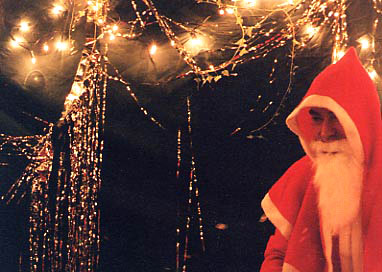
Well, that won me over. I agreed and so, late last Friday afternoon, I was dressed in full Santa costume and awaiting my first customer in a grotto like a Bedouin tent.

My first little visitor proved to be the one of more than 150 over the next two hours, by which time I had almost lost my voice with a mouth full of white synthetic hair.

But it was great! All that hope and expectation on those little faces was an inspiration. I had never before fully appreciated how much pleasure and joy the myth of Saint Nicholas brings to the young.

I asked every child if they had been good that year and they all said: 'Yes!' 


Life is getting better. The Day-Job has been good; order has returned to my Leamington existence, and I have been writing much more poetry.

There are also good omens, such as the return of my wristwatch. I was given it on my birthday. My sixth birthday, some 39 years ago. It was a present from my German grandparents (now long dead).

On the back is engraved 'Oma und Opa. 22/12/67'. I recall proudly wearing this full-sized man's watch on that day in 1967 – while The Beatles were still together and before Man walked on the Moon!

I wore it until, I believe, my third year at Hull University when at this time of year in 1982 I lost it at the Silhouette Club, then on Spring Bank. I do not recall what happened that night in that club, although I did return many times in the hope of finding my watch.

My grandfather had died by that time and I swore that I would never wear another wristwatch until it was recovered.

Last month when clearing out the London Garret, I found the watch at the bottom of an old biscuit tin I had used to knick-knacks while at Hull University. I had had no idea it was there and hadn't seen it for almost a quarter of a century. Its face was smashed and, obviously, it was not keeping time.

Now, thanks to an old watchmaker in Lewes, my beloved Kienzle is returned to its pristine state, with new glass and a repaired mechanism. The watch is back on the wrist!

Merry Christmas, Y'all!

Labels: , , , , , , ,

Monday, October 16, 2006

Sam Towers 1918-2006

Sam Towers 1918-2006

Cotesbach Garret. Sam Towers was laid to rest today in the churchyard at St Mary’s, Cotesbach.

The funeral was a wonderful celebration of his life. The clergyman spoke of Sam having been ‘blessed with a sense of well being’ and ‘imparting it to everyone who had contact with him’.

St. Mary’s, Cotesbach was packed. People had come from far and wide to pay their last respects to Sam.

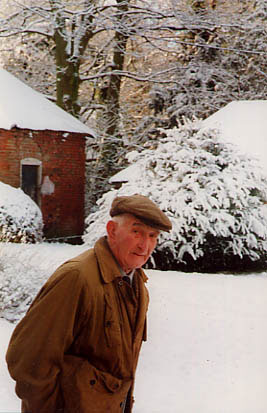
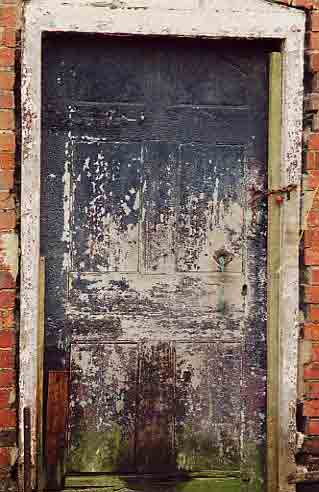
When I was living here in the garret of Cotesbach Hall where I am again as I write this, I would see Sam Towers almost every day. He would walk across the yard carrying his leather bucket on his way to tend to his hens in the old schoolhouse behind the battered door (pictured) and to dig his vegetable garden.

Sam was almost immaculate in his smart brown coat, tweed jacket, shirt, tie and cloth cap.

He would stop for a chat, tell an old yarn, talk about his garden or spread a little country wisdom, so very often ending with one of his favourite phrases: ‘Do a little, leave a lot’.

Sam Towers was wonderful with children. He always found time for people, young, old and in between. He was not a traveller. As the priest said ‘he liked to be where he belonged’ among his family.

He loved animals, except foxes. I remember being with Sam in 'the covers’ (the woods) when he produced his ‘barking iron’ (gun) and shot a fox – to prevent it from killing his beloved hens.

The funeral service was fascinating. I had forgotten that Sam was one of 10 children and also about his time with the South Atherstone Hunt and as a gamekeeper. I did recall Sam had been a jockey half a century ago; his love for horses was certainly great.

Sam came to Cotesbach when he married in 1948 and kept a garden outside his cottage and a vegetable plot in the grounds of Cotesbach Hall for around half a century.

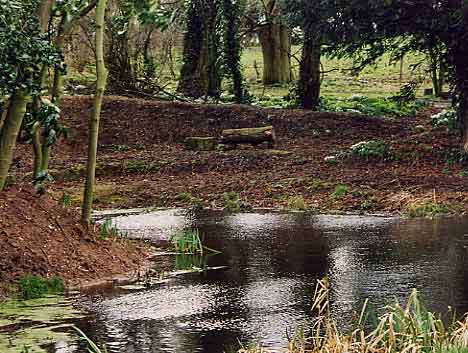
He was often around when we lived there and was always willing to lend a hand. If there was a rope to be pulled or a ladder to be held, Sam Towers would be on the end of it. More often we would bump into each other beside the village pond (pictured) and have a chinwag about life.

After the gentlemen of Wilf Smith & Son Funeral Directors had carried Sam’s coffin out into the churchyard where he is now buried, the mourners shuffled around chatting outside the church door.

Family members followed traditional by casting clumps of earth into the open grave. It struck me that although Sam Towers had physically been a small man, his presence had been great.

I visited Sam late last year at his cottage. Illness had dimmed his eyes a tad but his friendliness and hospitality were undiminished.

His widow Dorothy – or Doll, as the vicar called her – and the family invited everybody to Cotesbach Village Hall for the wake.

I thought of how Sam was born in 1918 at the end of the Great War and served in the Second World War. He told me ‘bad water’ had done for him and he could not sup alcohol.

Over the years I have attended many events at the Village Hall but none has been as full of joy as this one. Sam’s spirit seemed among us.

Back at base, my friend Phil and I retired to the Sickle & Stick to continue the wake. Gradually the room filled up and by the end of the evening it was busy.

I wrote about Sam Tower's life and send-off in the Sickle & Stick Book. And then something extraordinary happened. A Polish girl wandered in. This was amazing because the Sickle & Stick is the equivalent of a shed in a field in an obscure nook in the back of beyond. It does not get uninvited visitors.

The girl, in her early twenties, said her car had broken down on a distant road and she had wandered across the fields and stumbled on this dwelling. She seemed greatly down in the dumps.

We sorted her out with a drink and she explained that she had that day failed to land a menial job and had been dumped by her boyfriend.

She brightened up a little warming her feet beside he roaring fire we had built, and told us she had trained a journalist in Poland.

With a twinkle in my eye I told her of my time as the Editor of the Cotesbach Bell (ignoring my real journalistic pedigree), a newsheet dedicated to life in Cotesbach, a hamlet with a population of around 150.

I mentioned the newspaper's finest moment – recruitment the then 82-year-old Sam Towers as its star columnist. This occurred after I approached him beside the henhouse with a tape recorder and said: ‘Hi Sam, I’d like you join the Bell as columnist please. Tell me about your garden!’

Without so much as a moment of hesitation, Sam fluently expressed his views on his garden and the weather and life. Five minutes later I turned off the tape and thanked him.

All I had to do was transcribe his words to have the column verbatim!

When the Polish girl left, she asked if she could write something in the Sickle & Stick Book. After her taxi had spirited her away, we read out her entry. She said her visit had turned despair into joy. She had found her purpose. Now she knew what she wanted to with her life.

To be frank I was unsure what she meant. Phil said he knew: hearing about how a hamlet the size of Cotesbach could have a newspaper (even for a short time) had inspired her. Reading Sam's column had rekindled her love of journalism

I wondered if she had not just been taken by the pure country life; the simple values epitomised by Sam that we had told her about.

Whatever the case, she had experienced an epiphany in the Sickle & Stick.

Somehow the torch of Sam Towers had been mystically passed on to a new generation.


Here's Sam's column:

Sam says…

Gardening by Sam Towers

I’ve been gardening in Cotesbach for 50 years and try to do some every day. I always say, ‘Do a little. Leave a lot’, though at this time of year it’s best to get it done. Plant as soon as you can now!

Peas, beans, onions can all go in. I put the onions in no more than three-quarters of an inch deep. Don’t forget to hoe the weeds off and pull the soil away as they get a bit bigger.

Kidney beans don’t want to go in for another couple of weeks. I always put them in on the fifteenth of May. Just plant them in a row.

With the peas, make a trench an inch-and-a-half to two inches deep and plant them three in a row, spaced two inches apart.

Yesterday I put in parsnips and carrots. I always put in carrots a bit on the thick side.

There’s still a bit of frost about but it won’t hurt, so long as your seeds are covered up in soil.

It’ll soon be time for cabbage plants - any day now. But it’s been a bad old time for digging, what with the wet.

You should be in the garden every day. There’s always a job to do. But as I say: ‘Do a little. Leave a lot!’

Labels: , , , , , , ,